

1 min read
Custom Cabling Checklist: 10 Questions to Answer Before Manufacturing Begins
Before placing a custom cable order, verify the application, connector requirements, cable specifications, environmental conditions, compliance...
12 min read
Bob joined Turn-key Technologies in 2011, and helped launch TTI Cable, which is the structured cabling division of TTI. Additionally, he created TTI Fiber which is our overseas affiliate for fiber optic cable manufacturing. With over 20 years of experience in both domestic and international trade and sales, Bob has dedicated himself to providing each and every client with the best solution for their networking needs. It has been under Bob’s supervision that he has created an equally experienced ...
Bob Gissubel
Updated on June 26, 2026
The cable manufacturing process lifecycle encompasses every stage involved in creating a cable product, from requirements gathering and engineering to material sourcing, manufacturing, testing, and final delivery. While buyers often focus on the finished cable, long-term performance and reliability are largely determined by decisions made throughout this lifecycle.
That distinction matters because cable reliability is built long before the product reaches the customer. Material selection, connector compatibility, tolerance control, termination quality, inspection procedures, and testing protocols all influence whether a cable performs consistently in the field. A reliable cable is not simply produced. It is engineered, validated, and managed through a series of controlled processes.
Whether the final product is a fiber optic assembly, copper patch cord, power cable, media interface solution, or custom OEM/ODM assembly, every stage influences performance, durability, and deployment outcomes. This article explores how quality is built throughout the cable manufacturing process lifecycle and why understanding that process can help engineers, OEMs, integrators, contractors, and procurement teams make more informed decisions.
Core Principle: Cable quality is built throughout the entire manufacturing lifecycle, not just during final production or testing.
What Drives Reliability: Product design, material selection, connector compatibility, process control, inspection procedures, and testing protocols all influence long-term performance.
Common Risk: Focusing only on product specifications can overlook manufacturing, sourcing, and quality-control factors that affect consistency and reliability.
What to Evaluate: Engineering capabilities, manufacturing processes, testing standards, supply chain stability, and traceability practices.
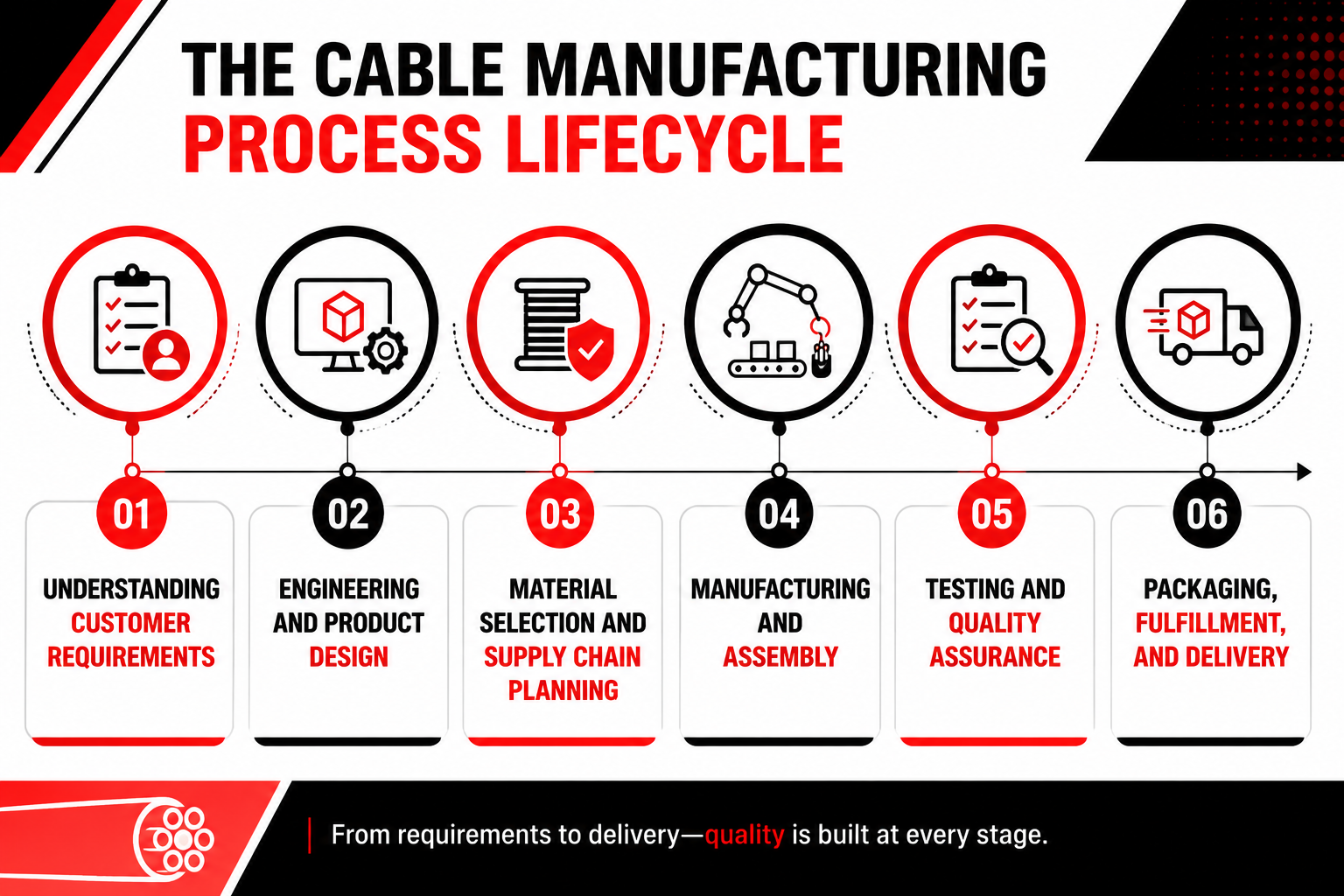
Key Lifecycle Stages: Requirements gathering, product design, material sourcing, manufacturing, testing, packaging, and delivery.
Operational Impact: Strong lifecycle management helps reduce field failures, improve deployment outcomes, and support consistent product performance.
Recommended Approach: Evaluate cable manufacturers based on the maturity of their processes, not just the specifications of the finished product.
When evaluating cable products, most buyers focus on specifications. Conductor type, connector configuration, cable length, environmental ratings, and performance requirements are all important considerations.
However, specifications only describe the finished product. They do not reveal how consistently that product can be manufactured, tested, and delivered over time.
Understanding the cable manufacturing process lifecycle provides insight into something equally important: process maturity. Mature processes help reduce variability, improve quality consistency, and support more predictable outcomes across production runs. For organizations deploying connectivity infrastructure at scale, those factors can be just as important as the specifications themselves.

Reliable products are rarely the result of a single manufacturing step. They are the outcome of disciplined engineering, controlled manufacturing processes, thorough testing, and consistent quality assurance practices. When those systems work together effectively, the result is greater product consistency and fewer surprises in the field.
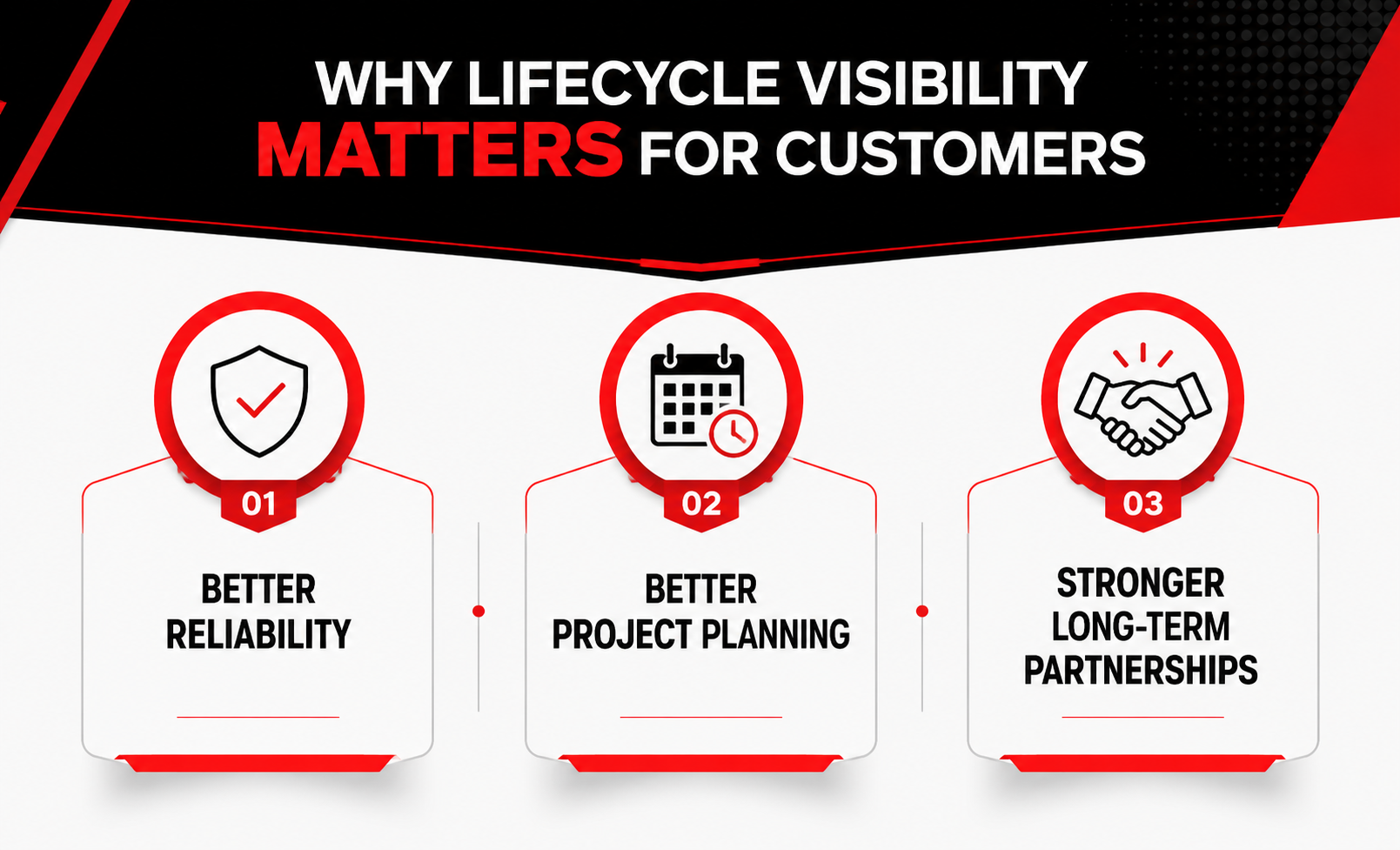
The benefits of lifecycle visibility extend beyond product performance. Organizations with mature manufacturing and supply chain processes are often better equipped to provide realistic lead times, communicate production status, and manage changes when they occur.
For contractors, OEMs, and procurement teams, that visibility can help reduce deployment risk and improve project planning.
Transparency creates trust.
Customers benefit when they understand how products are engineered, manufactured, tested, and supported throughout their lifecycle. Greater visibility into these processes makes it easier to evaluate potential suppliers, identify risks, and build long-term partnerships based on consistency rather than assumptions.
Before examining each stage of the cable manufacturing process lifecycle, it is important to understand that quality is not created at a single point in production. It is built through a series of decisions, controls, and verification steps that begin long before manufacturing starts.

The cable manufacturing process lifecycle begins long before production starts. Before a conductor is selected, a connector is specified, or materials are sourced, the intended application must be clearly defined. This stage establishes the foundation for every decision that follows, influencing cable design, manufacturing requirements, testing procedures, and long-term performance expectations.
Many cable failures are not caused by manufacturing defects. They are caused by specification mismatches. A cable designed for a climate-controlled data center may not perform reliably in an industrial environment exposed to vibration, moisture, chemicals, or temperature extremes. Likewise, a cable optimized for high-speed data transmission may not be suitable for power delivery applications or installations that require continuous flexing.
The first objective is understanding how the cable will be used throughout its operational life. Factors such as electrical or optical performance requirements, installation environment, expected lifespan, mechanical stress, and applicable industry standards all influence the final design. Decisions made at this stage determine everything from material selection and connector compatibility to testing requirements and environmental protection measures.
Overlooking a requirement early in the process can create problems that are difficult and expensive to correct later. What appears to be a manufacturing issue is often the result of an incomplete understanding of the application itself.
Once application requirements are established, engineering teams define the technical parameters that will shape the design. These constraints may include cable length limitations, bend radius requirements, signal integrity objectives, voltage ratings, connector interfaces, and durability expectations.
For high-performance data assemblies and power cables, even seemingly minor design decisions can have significant operational consequences. A connector choice, conductor specification, or environmental rating that appears adequate on paper may introduce installation challenges, maintenance concerns, or performance limitations in the field.
Successful cable design is ultimately an exercise in balancing priorities. Performance, reliability, manufacturability, cost, scalability, and lead time all influence the final product, and improving one area often affects another.
For example, a premium material may improve durability and performance while increasing production costs or introducing supply chain complexity. Understanding these tradeoffs early helps reduce risk, avoid costly redesigns, and create a smoother path into engineering, sourcing, and manufacturing.
Read next: Don't Let Bad Cabling Break Your Network: A Complete Guide to Structured Installation
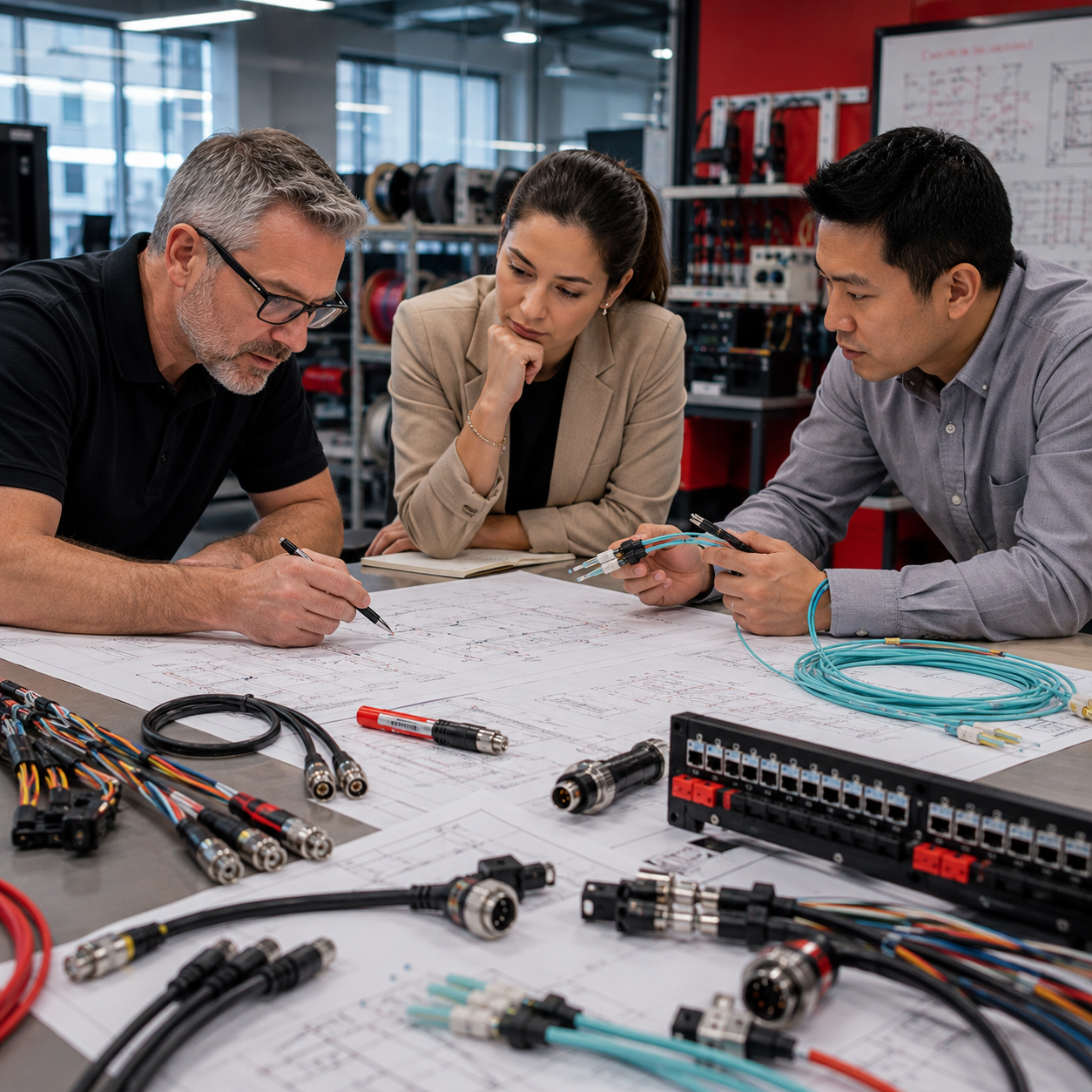
Once requirements are defined, engineering teams begin translating those objectives into a product that can be manufactured consistently, tested effectively, and deployed reliably.
This stage serves as the bridge between application requirements and production. A design that performs well in theory still needs to be manufacturable at scale, supported by available materials, and capable of meeting quality requirements throughout its lifecycle.
The engineering process converts performance goals into specific design decisions. These decisions shape the cable structure, component selection, environmental protections, connector interfaces, and overall construction of the product.
Every choice introduces tradeoffs. A material selected for flexibility may offer different environmental characteristics than one chosen for chemical resistance. Additional shielding may improve protection against interference but increase cable diameter and complexity. Connector selections can influence installation requirements, maintenance accessibility, and long-term serviceability.
The objective is not simply selecting the highest-performing components. It is creating a design that aligns technical requirements with real-world deployment conditions.
A critical part of product design is determining whether a solution can be manufactured and supported consistently over time.
Before production begins, engineering teams evaluate questions that extend beyond technical performance. Can the design be manufactured repeatedly within acceptable tolerances? Are the specified materials readily available? Does the design introduce unnecessary production complexity? Can future demand be supported without disrupting supply?
Addressing these questions early helps identify risks before they become production challenges, reducing the likelihood of delays, redesigns, or quality issues later in the lifecycle.
For many projects, prototypes provide an opportunity to validate assumptions before committing to full-scale production.
A prototype can reveal issues that may not be obvious during the design phase, including connector fitment challenges, routing constraints, installation concerns, or durability limitations. These early evaluations help ensure the final product performs as intended, not only in testing environments but also in real-world deployments.
The value of prototyping is often less about proving a design works and more about identifying opportunities for improvement before manufacturing begins. Early validation can help reduce deployment risk, improve product consistency, and prevent costly changes later in the process.
Read next: Understanding the Difference Between OEM and ODM in Custom Cables
A well-engineered design does not automatically result in a high-quality product. The materials used to build that design and the systems used to source them play an equally important role in long-term performance.
Even the most advanced manufacturing process cannot compensate for inconsistent materials. Variations in conductor quality, insulation properties, connector tolerances, shielding effectiveness, or environmental protection materials can affect everything from electrical performance and durability to installation reliability and product lifespan.
Material selection is ultimately about matching product requirements to operating conditions.
Engineers must evaluate how different materials will perform under the environmental, electrical, and mechanical demands of the application. Factors such as conductivity, flexibility, temperature resistance, chemical exposure, electromagnetic interference (EMI), and physical durability can all influence the final design.
The challenge is that no material excels in every category. Improving performance in one area often introduces tradeoffs elsewhere. A more durable jacket material may reduce flexibility. Additional shielding may improve noise protection while increasing cable size and complexity. Material selection requires balancing these competing priorities against the realities of the deployment environment.
| Material Consideration | Why It Matters | Questions to Ask |
|---|---|---|
| Electrical Performance | Influences signal integrity, conductivity, and power transmission | What performance requirements must the cable support? |
| Environmental Resistance | Affects durability in moisture, chemicals, UV exposure, and temperature extremes | Where will the cable be deployed? |
| Mechanical Durability | Impacts flexibility, bend radius, and resistance to physical stress | Will the cable experience vibration, movement, or repeated handling? |
| Shielding Requirements | Helps protect against electromagnetic interference (EMI) | Is the installation environment electrically noisy? |
| Connector Compatibility | Influences installation, maintenance, and system interoperability | What equipment and interfaces must the cable support? |
| Supply Chain Availability | Affects lead times and long-term production consistency | Can materials be sourced reliably throughout the product lifecycle? |
Quality is not created solely through engineering and manufacturing. It also depends on the ability to source consistent materials over time.
Component shortages, supplier changes, material substitutions, and long lead times can all affect production schedules and product consistency. For organizations managing large deployments or recurring production runs, these risks can have operational consequences that extend well beyond manufacturing.
As a result, experienced cable manufacturers place significant emphasis on supplier qualification, traceability, and long-term sourcing strategies. The objective is not simply securing materials. It ensures that those materials remain available and consistent throughout the product lifecycle.
| Supply Chain Factor | Potential Risk | Operational Impact |
|---|---|---|
| Component Shortages | Production Delays | Extended Lead Times |
| Supplier Changes | Material Variability | Product Consistency Concerns |
| Long Procurement Cycles | Inventory Constraints | Project Schedule Disruptions |
| Limited Source Availability | Increased Dependency | Reduced Manufacturing Flexibility |
| Inadequate Traceability | Quality Investigation Challenges | Slower Issue Resolution |
Once materials have been selected and sourcing strategies established, planning shifts toward execution. Production schedules, inventory management, manufacturing capacity, and logistics must be aligned to support customer requirements while maintaining quality standards.
Strong planning helps reduce delays, improve predictability, and support consistent production outcomes. It also creates a smoother transition into the next stage of the lifecycle, where engineering plans and material selections become physical products through manufacturing and assembly.
Once materials have been qualified and production plans are in place, the cable manufacturing process lifecycle moves into manufacturing and assembly. This is where engineering decisions, material selections, and production planning become physical products.
While manufacturing methods vary across cable types and applications, the objective remains the same: to produce cables consistently while maintaining performance specifications and quality requirements.
For custom cable assemblies, consistency often matters as much as performance. A product that performs well in one production run but varies across future batches introduces risk for OEMs, contractors, system integrators, and infrastructure operators.
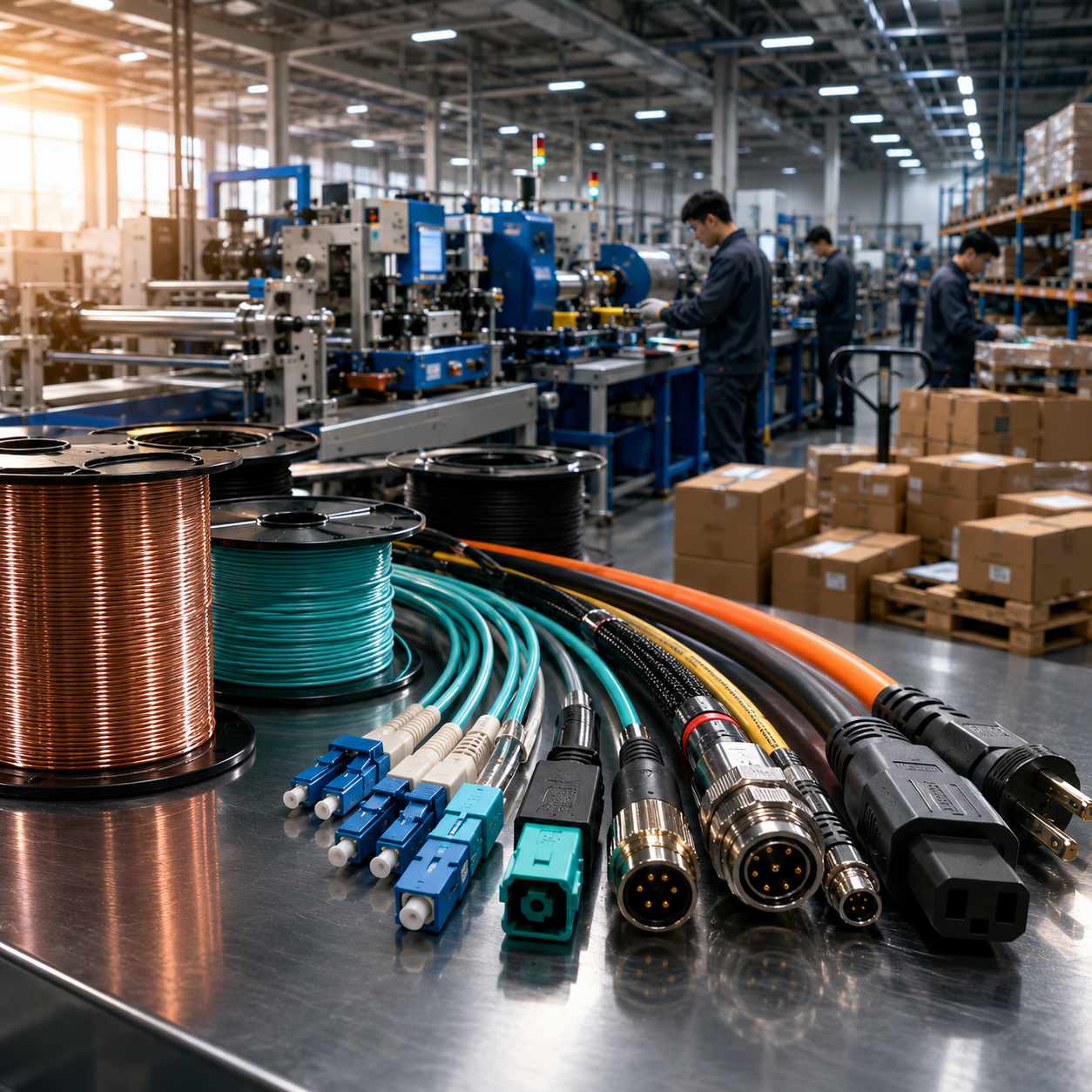
Manufacturing begins with preparing and assembling the components that make up the final product. Depending on the application, this may involve conductor preparation, insulation application, connector preparation, cable assembly, shielding, labeling, and other production processes.
In traditional wire and cable manufacturing, processes such as conductor drawing and insulation extrusion help establish the electrical and mechanical characteristics of the finished product. Although these steps are rarely visible to end users, they play an important role in determining cable performance, durability, and long-term reliability.
Assembly requirements vary significantly depending on the application.
Fiber optic assemblies require precise optical termination to maintain signal performance. Copper assemblies depend on reliable electrical terminations, while power cables require secure conductor connections capable of supporting their intended load.
At this stage, even small variations can affect long-term performance. Connector alignment, termination quality, insulation placement, and assembly precision all influence reliability in the field.
The most effective manufacturing operations focus not only on producing products but on producing them consistently.
Process control systems help reduce variation between production runs and ensure products continue to meet established specifications over time. Operator training, documented procedures, equipment calibration, in-process inspections, traceability systems, and quality checkpoints all contribute to that objective.
For customers, the value of process control is straightforward: greater consistency. A mature manufacturing process helps ensure that the cable received today performs the same way as the cable received six months from now.
For OEM programs, recurring deployments, and large-scale infrastructure projects, that level of repeatability can be just as important as the performance of the product itself.
Read next: Fiber Optic Cable vs Copper Cable: Key Differences
Manufacturing alone does not guarantee quality.
Before a product is shipped, it must be verified against the requirements established during design and engineering. Testing and quality assurance provide that verification, helping confirm that the finished cable performs as intended under its expected operating conditions.
Testing requirements vary depending on the product and application. Fiber optic assemblies, copper cable systems, power cables, and custom cable assemblies each require different validation methods based on their intended use.
Depending on the design, testing may evaluate electrical continuity, signal integrity, optical performance, insertion loss, return loss, voltage characteristics, or other performance criteria. The objective is straightforward: confirm that the cable performs according to specification before deployment.
For custom OEM/ODM cable assemblies, verification can be especially important. As designs become more application-specific, testing helps ensure the finished product meets both performance requirements and manufacturing expectations.
Performance is not defined solely by electrical or optical characteristics. Environmental exposure, installation conditions, and mechanical stress can all influence long-term reliability.
For fiber optic assemblies, connector inspection and cleaning should be treated as formal quality-control steps, not informal handling practices. The Fiber Optic Association’s 2025 FOA-8 Inspection and Cleaning of Fiber Optic Connectors Standard calls for technicians to inspect after cleaning, repeat the process until the connector is acceptable, and document key test details. This reinforces why mature testing programs need repeatable procedures and traceability records, not just pass-or-fail results.
For this reason, quality assurance programs often evaluate factors such as flexibility, pull strength, connector retention, vibration resistance, and environmental durability, particularly for products intended for industrial, transportation, or outdoor environments.
Testing generates more than pass-or-fail results. Inspection records, manufacturing history, compliance documentation, and traceability data help create visibility throughout the product lifecycle.
For customers managing large deployments, recurring production runs, or custom OEM/ODM programs, this documentation provides confidence that quality is supported by documented processes, verification procedures, and repeatable manufacturing practices.
Ultimately, testing and quality assurance validate that the decisions made during design, material selection, and manufacturing have resulted in a product that is ready for deployment.
Read next: Active Optical Cables in Data Centers: A Guide to Faster, Smarter Connectivity
A product's lifecycle does not end when manufacturing and testing are complete.
Even a well-designed, properly manufactured cable can create deployment challenges if it arrives damaged, mislabeled, incomplete, or late. The final stage of the cable manufacturing process lifecycle focuses on preserving product integrity and ensuring that customers receive exactly what was specified.
Packaging serves a practical purpose: ensuring that the cable arrives in the same condition it left the manufacturing facility.
Requirements vary depending on the product. Factors such as cable length, connector sensitivity, environmental exposure, shipping distance, and product complexity can all influence packaging decisions. The objective is to protect the product from crushing, contamination, moisture exposure, and other forms of damage that could affect performance or installation.
Before shipment, products are typically verified against order requirements, including configuration details, quantities, labeling, and supporting documentation.
While these checks may seem routine, errors at this stage can create project delays, installation challenges, and unnecessary operational costs. Accuracy remains just as important during fulfillment as it is during manufacturing.
Delivery is often the first stage of the lifecycle that customers directly experience. As a result, logistics planning plays an important role in overall project success.
For infrastructure projects, production schedules, inventory availability, and customer deadlines must all be coordinated to support deployment timelines. A delayed component can affect installation schedules, resource planning, and project execution, regardless of how well the product performs once it arrives.
The goal of this final stage is straightforward: ensure that the quality built throughout the lifecycle is preserved all the way to deployment.
Not all cable manufacturers approach product development, manufacturing, and quality control the same way. While product specifications are important, they only tell part of the story.
A cable's long-term performance is influenced by the systems, processes, and expertise behind it. Evaluating a manufacturing partner requires looking beyond the finished product and assessing how quality is built, maintained, and verified throughout the cable manufacturing process lifecycle.
| Evaluation Area | Questions to Ask |
|---|---|
| Engineering Expertise | Can they support custom product and process design requirements? |
| Manufacturing Capability | Can they scale production while maintaining consistency? |
| Testing Programs | How are performance and quality requirements validated? |
| Process Control | How is manufacturing variation monitored and managed? |
| Supply Chain Management | How are sourcing risks and material consistency addressed? |
| Quality Systems | Is traceability maintained throughout production? |
| Customer Support | Can they support projects beyond product delivery? |
When evaluating potential partners, it is often helpful to look beyond the finished product and examine the processes behind it. Manufacturing capabilities, quality control systems, material traceability, and production consistency can all have a significant impact on long-term performance.
Organizations with specialized requirements should also consider the level of engineering support available. Custom cable solutions often require collaboration on product design, testing, validation, and production planning, particularly for unique applications or recurring production programs.
For companies exploring custom cable development, TTI Cable's OEM/ODM Services provide support throughout the product lifecycle, from design and prototyping to manufacturing and fulfillment. Ultimately, the answers to these questions often reveal more about future project outcomes than product specifications alone.
Read next: Understanding the Difference Between OEM and ODM in Custom Cables
When a cable arrives on-site, most of the decisions that determine its performance have already been made. Requirements gathering, engineering, material selection, manufacturing, testing, and fulfillment all play a role in whether a product performs reliably in the field.
Organizations that consistently deliver quality products are often those that manage the entire cable manufacturing process lifecycle with discipline, transparency, and repeatability. Understanding the lifecycle helps engineers, OEMs, contractors, and procurement teams make more informed decisions when evaluating suppliers and planning infrastructure investments.
Key Takeaways:
Quality begins before manufacturing starts.
Product design influences long-term reliability.
Material selection affects performance and durability.
Process control supports manufacturing consistency.
Testing validates performance before deployment.
Supply chain planning influences lead times and availability.
Lifecycle visibility helps reduce operational risk.
Strong manufacturing processes contribute to better project outcomes.
Whether you're developing a custom assembly, evaluating OEM/ODM options, or planning a large-scale infrastructure project, understanding the lifecycle behind the product can help support better decision-making.
The cable manufacturing process includes every stage involved in transforming raw materials into a finished cable product. The process typically includes requirements gathering, product design, material selection, conductor preparation, insulation application, manufacturing, assembly, testing, packaging, and delivery. Each stage contributes to the performance, reliability, and useful life of the finished cable.
In traditional wire and cable manufacturing, the drawing process reduces copper stock to the required conductor diameter while maintaining electrical conductivity. The extrusion process applies insulation material or protective polymer layers around the conductor. These manufacturing steps help establish the electrical, mechanical, and environmental characteristics of the finished cable.
Cable insulation plays a critical role in electrical performance, durability, and environmental protection. Different insulation materials, including thermoplastic and XLPE compounds, offer varying levels of flexibility, temperature resistance, chemical resistance, and protection against harsh environmental conditions. Selecting the appropriate insulation material depends on the intended application and operating environment.
In addition to product specifications, buyers should evaluate engineering expertise, manufacturing capabilities, quality control systems, testing programs, supply chain stability, and process control practices. Manufacturers that support custom development, process improvements, automation, and OEM/ODM programs may be better positioned to support specialized requirements and long-term production needs.
End-of-life considerations vary depending on the application, materials, and installation environment. Organizations may evaluate replacement planning, material recovery opportunities, recycling programs, and broader life cycle assessment objectives when managing infrastructure upgrades. For large deployments, understanding the entire life cycle of a cable system can help support more informed planning and sustainability initiatives.
1 min read
Before placing a custom cable order, verify the application, connector requirements, cable specifications, environmental conditions, compliance...

1 min read
Organizations today rely on high-speed data transmission to keep up with increasing workloads, large data transfers, and real-time applications. From...
1 min read
Direct Attach Cables (DACs) are gaining popularity in data centers because they provide a cost-effective, low-latency, and power-efficient way to...