


Skip to the main content.

10 min read

How to Future-Proof Your Network Cabling Infrastructure

Written by Updated July 30, 2026
Picture of Bob Gissubel
Bob Gissubel

Bob joined Turn-key Technologies in 2011, and helped launch TTI Cable, which is the structured cabling division of TTI. Additionally, he created TTI Fiber which is our overseas affiliate for fiber optic cable manufacturing. With over 20 years of experience in both domestic and international trade and sales, Bob has dedicated himself to providing each and every client with the best solution for their networking needs. It has been under Bob’s supervision that he has created an equally experienced ...

How to Future-Proof Your Network Cabling Infrastructure

Future-proofing your network cabling means designing a cabling infrastructure that can support higher bandwidth, new technologies, and future expansion without requiring extensive rewiring. By selecting the right combination of structured cabling, fiber optic and copper cabling, pathway capacity, and standards-based design, organizations can reduce upgrade costs, minimize disruption, and extend the useful life of their network infrastructure.

This approach is becoming increasingly important as organizations deploy multi-gigabit Ethernet, Wi-Fi 6 and Wi-Fi 7 access points, IoT devices, automation systems, and other high-density applications that place greater demands on network connectivity. While switches, routers, and wireless equipment may be replaced every few years, the cabling system behind them is often expected to remain in service for a decade or longer. Decisions made during planning and installation can determine whether future upgrades are straightforward or require costly infrastructure changes.

The importance of long-term infrastructure planning is reflected in recent industry research. According to Uptime Institute's Annual Outage Analysis 2025, 54% of organizations reported that their most recent significant outage cost more than $100,000, while one in five reported losses exceeding $1 million. Although outages have many causes, resilient infrastructure planning and sound network design remain key factors in reducing operational risk and simplifying future growth.

💡 TL;DR: The Planning Priorities That Matter Most

A scalable network starts with infrastructure that can adapt to changing technologies and increasing bandwidth demands. Keep these planning priorities in mind before specifying or upgrading your cabling system:

  • Plan for tomorrow's bandwidth, not just today's needs. Design your network cabling to support higher speeds, additional devices, and future technologies without requiring major rewiring.
  • Choose the right cabling for long-term performance. Cat6A remains a strong choice for many enterprise copper deployments, while fiber optic cables provide the bandwidth and distance needed for backbone connections and high-growth environments.
  • Leave room for expansion. Size pathways, racks, cable trays, and telecommunications spaces to accommodate future cable runs, access points, and network equipment.
  • Follow recognized structured cabling standards. Standards-based designs improve interoperability, simplify future upgrades, and help maintain consistent network performance throughout the infrastructure lifecycle.
  • Invest in cable management and documentation. Proper labeling, organized patch panels, and accurate records make it easier to troubleshoot, expand, and maintain a growing network.
  • Think in decades, not technology cycles. Active equipment will be replaced several times over the life of your cabling system, making proper planning one of the most cost-effective investments in long-term network infrastructure.

Planning Network Cabling for Long-Term Growth

Unlike switches, routers, servers, and wireless access points, network cabling is expected to remain in service for many years. Once installed behind walls, above ceilings, or beneath raised floors, replacing or expanding a cabling system can become one of the most disruptive and expensive parts of a network upgrade. That's why infrastructure planning should account for future growth, not just current performance requirements.

As organizations adopt faster Ethernet standards, deploy more connected devices, and expand wireless coverage, the physical cabling infrastructure must be able to support increasing bandwidth demands without becoming a bottleneck. Designing for scalability from the outset helps reduce future upgrade costs, minimizes operational disruption, and provides greater flexibility as business and technology requirements evolve.

The table below highlights several common technology trends and the infrastructure considerations they introduce.

Technology Trend Infrastructure Impact Planning Consideration
Multi-Gigabit Ethernet Higher bandwidth demands on horizontal cabling Select cabling that supports anticipated speeds over the intended service life.
Wi-Fi 6 and Wi-Fi 7 Access Points Increased backhaul capacity requirements Plan for higher-performance copper cabling and sufficient pathway capacity for additional access points.
IoT Devices, Security Systems, and Building Automation More connected endpoints throughout the facility Reserve space for future cable runs, patch panels, and telecommunications rooms.
Fiber Optic Backbone Expansion Greater bandwidth over longer distances Incorporate fiber optic cabling where longer links or future scalability are expected.
Higher-Density Network Environments Increased cable counts and heat within pathways Design cable management, racks, and pathways to accommodate future growth while maintaining accessibility.

Network Cabling Is a Long-Term Infrastructure Investment

One of the most common planning mistakes is treating network cabling as if it follows the same refresh cycle as networking hardware. In practice, switches, routers, and wireless access points are often replaced several times before the underlying cabling infrastructure is upgraded.

Viewing cabling as a long-term infrastructure investment encourages better decisions during the design phase. Selecting appropriate cable categories, allowing capacity for expansion, documenting installations, and following structured cabling standards can help organizations accommodate future technologies while reducing the cost and disruption of later upgrades.

Key Considerations When Planning a Future-Proof Network

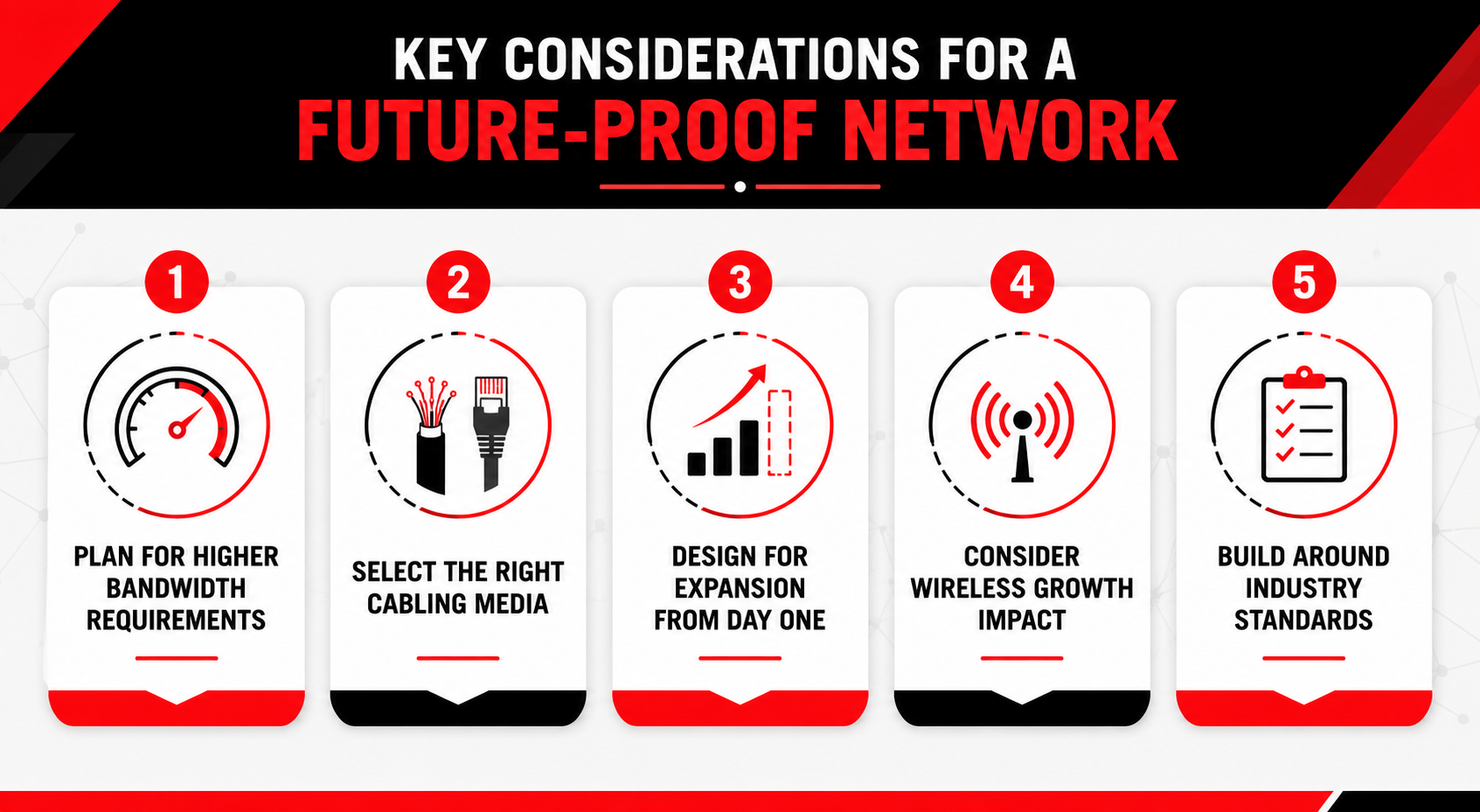
Future-proofing your network begins with making infrastructure decisions that remain effective long after today's hardware has been replaced. While no one can predict exactly how technology will evolve, organizations can design cabling systems that are better prepared for higher bandwidth, additional devices, and changing operational requirements.

Rather than focusing on a single cable type or performance specification, effective planning considers the entire infrastructure, from cabling media and pathway capacity to network architecture, standards compliance, and room for future expansion. The following considerations can help you build a scalable network that supports future growth while reducing the cost and complexity of future upgrades.

Plan for Higher Bandwidth Requirements

Bandwidth demands rarely remain static. Cloud applications, unified communications, AI workloads, high-resolution video, and increasing numbers of connected devices continue to push network utilization higher. While your current infrastructure may support today's traffic, it should also provide headroom for future applications that require greater throughput.

Rather than specifying cabling based solely on immediate requirements, evaluate how the network is expected to evolve over the next 10 to 15 years. Installing higher-performance cabling during construction or renovation is typically far less disruptive and less expensive than replacing cable after the building is occupied.

Select the Right Cabling Media

One of the most important planning decisions is determining where copper and fiber-optic cabling are most appropriate.

Copper cabling, including Cat6A, remains a practical choice for horizontal cabling that supports workstations, wireless access points, IP phones, and many Power over Ethernet (PoE) applications. Fiber optic cabling is often the preferred solution for backbone connections, inter-building links, data centers, and other applications that require longer transmission distances, higher bandwidth, or greater immunity to Electromagnetic Interference (EMI).

Organizations designing high-capacity fiber backbones or data center networks often rely on TTI Cable's MTP®/MPO Assemblies to simplify high-density fiber deployments while supporting future expansion.

Read Next: Fiber Optic Cable vs Copper Cable: Key Differences


Design for Expansion from Day One

Many networks outgrow their available pathways long before the installed cabling reaches the end of its service life.

Leaving spare capacity in conduits, cable trays, telecommunications rooms, and equipment racks makes future expansion significantly easier. Additional pathway space also simplifies moves, adds, and changes while reducing the risk of overcrowded cable bundles that complicate maintenance and airflow.

Planning for expansion also means considering how future connections will be organized. TTI Cable's Fiber Patch Panels & Cassettes are designed to help manage higher fiber counts while maintaining accessibility for future additions, moves, and changes.

Consider the Impact of Wireless Growth

Although wireless connectivity continues to expand, every Wi-Fi access point ultimately depends on a wired network connection.

Modern Wi-Fi 6 and Wi-Fi 7 deployments frequently require multi-gigabit Ethernet connections and increased Power over Ethernet capabilities to support higher user densities and improved wireless performance. As organizations add more access points to improve coverage and capacity, the underlying cabling infrastructure must also scale to support them.

Treat wireless expansion as much a cabling planning exercise as a wireless design exercise.

Build Around Industry Standards

Structured cabling standards provide a consistent framework for designing, installing, and maintaining network infrastructure.

Following recognized standards such as the ANSI/TIA-568 helps improve interoperability, simplifies maintenance, and makes future upgrades more predictable. Standards-based installations also reduce the likelihood of inconsistent cabling practices that can complicate troubleshooting or limit future expansion.

Designing to recognized standards is often less about compliance and more about creating infrastructure that remains organized, maintainable, and adaptable over time.

Read Next: Fiber Optic Cable vs. Copper Cable: Which One Will Power the Future of Your Network?

Choosing Cabling Infrastructure That Supports Future Growth

Selecting the right cabling infrastructure is about more than meeting current performance requirements. The best decisions account for how the network is expected to evolve over the next decade, helping organizations accommodate new technologies, higher bandwidth demands, and future expansion without requiring extensive rewiring.

When evaluating your infrastructure, focus on these key considerations:

  1. Choose the right cabling media for each application. Copper cabling, such as Cat6A, remains a practical choice for many horizontal Ethernet connections, while fiber optic cabling is better suited for backbone links, longer transmission distances, and high-bandwidth environments. Matching the cable type to the application helps optimize both performance and long-term scalability.

  2. Prioritize lifecycle value over upfront cost. While lower-cost cabling may satisfy today's requirements, replacing installed infrastructure is often far more expensive than selecting higher-capacity cabling during the initial deployment. Consider how long the cabling is expected to remain in service and whether it can support future technology upgrades.

  3. Build with room for growth. Leave spare capacity in conduits, cable trays, telecommunications rooms, equipment racks, and patch panels to simplify future expansion. Planning for additional cable runs and network equipment during the initial installation reduces disruption and helps control upgrade costs as the network grows.

Selecting the right cabling is only part of building a scalable network. Choosing connectivity solutions that align with your infrastructure design can also simplify deployment and support future expansion. TTI Cable offers a range of Fiber Solutions for enterprise, telecommunications, industrial, and data center environments, helping organizations build network infrastructures that remain organized, adaptable, and easier to maintain over time.

Read Next: Benefits of Fiber Optic Cable for Large Enterprise Networks

How to Evaluate Whether Your Network Is Future-Ready

One of the simplest ways to determine whether your network is prepared for future growth is to evaluate the infrastructure against your organization's long-term requirements rather than its current performance. A network that meets today's needs may still require significant upgrades if it cannot support additional users, higher bandwidth applications, or new technologies in the coming years.

Use the following checklist to identify areas that may require further planning before your next network expansion or technology refresh.

Evaluation Question Why It Matters
Can your current cabling support planned bandwidth upgrades? Higher network speeds often require infrastructure capable of supporting increased throughput without replacing existing cable runs.
Is there sufficient capacity for future expansion? Spare space in pathways, racks, patch panels, and telecommunications rooms simplifies future growth while reducing installation costs.
Are copper and fiber optic cabling being used where they provide the greatest value? Matching the transmission media to the application improves performance, scalability, and cost efficiency.
Does the infrastructure follow recognized structured cabling standards? Standards-based installations simplify maintenance, improve interoperability, and make future upgrades more predictable.
Is the cabling system well documented? Accurate labeling, test results, and network documentation reduce troubleshooting time and support future moves, adds, and changes.
Can the infrastructure accommodate future technologies? Planning for additional wireless access points, IoT devices, and higher-density network environments helps extend the useful life of the cabling system.

Completing this evaluation before upgrading network equipment can help identify infrastructure limitations early, allowing organizations to address potential constraints before they become costly obstacles to future expansion.

Read More: How to Choose the Right Fiber Media Converter for Your Network

Best Practices for Building a Future-Proof Network Infrastructure

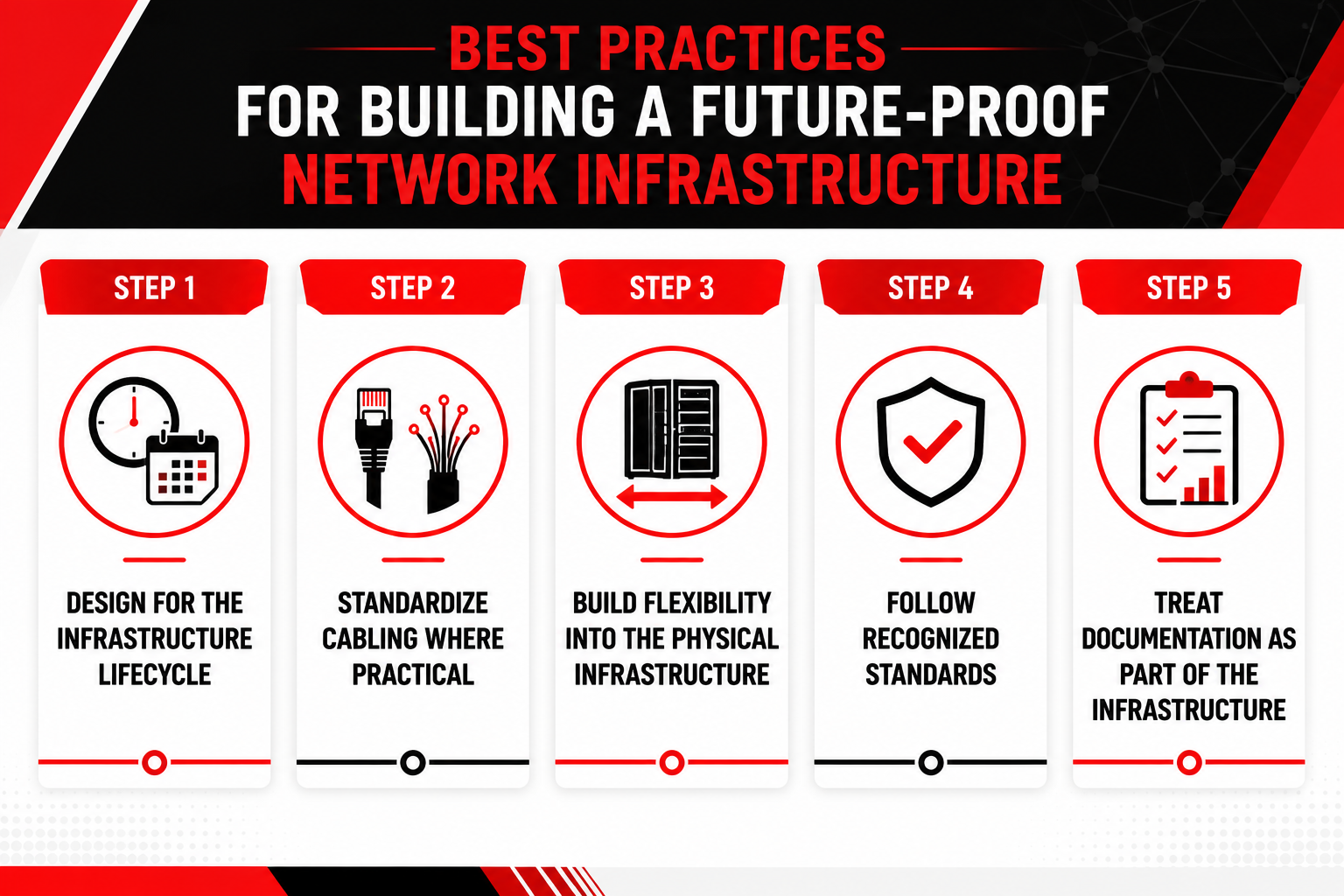
Future-proofing isn't about anticipating every technological advancement or deploying the highest-performing cabling available. Instead, it's about making infrastructure decisions that provide flexibility as network demands evolve. By following proven design and deployment practices, organizations can reduce the likelihood of costly retrofits, simplify future upgrades, and extend the useful life of their cabling infrastructure.

The following best practices can help you build a network that remains adaptable for years to come.

Step 1: Design for the Infrastructure Lifecycle, Not the Equipment Lifecycle

Network switches, servers, and wireless access points are typically replaced several times during the lifespan of a structured cabling system. Because the physical cabling infrastructure is expected to remain in service for much longer, design decisions should be based on long-term operational requirements rather than the specifications of today's equipment.

When evaluating cable categories, fiber types, and pathway capacity, consider where your organization expects to be in 10 to 15 years, not just at the time of installation. Planning for future bandwidth requirements, device growth, and emerging applications can significantly reduce the need for disruptive infrastructure upgrades later.

Step 2: Standardize Cabling Where Practical

Using a consistent approach to cable categories, connector types, labeling conventions, and installation practices simplifies both day-to-day operations and future expansion. A standardized infrastructure is easier to maintain, troubleshoot, and document, particularly across multiple buildings or locations.

Standardization also reduces complexity during technology refreshes by providing a predictable foundation for new equipment and minimizing compatibility concerns.

Step 3: Build Flexibility Into the Physical Infrastructure

Scalable networks depend on more than selecting the right cable type. They also require sufficient physical capacity to accommodate future growth.

Leaving spare space in conduits, cable trays, telecommunications rooms, equipment racks, and patch panels makes it easier to install additional cabling, deploy new hardware, or reconfigure the network without major construction or prolonged downtime. While unused capacity may appear unnecessary during the initial installation, it often becomes one of the most valuable investments as operational requirements change.

Step 4: Follow Recognized Structured Cabling Standards

Industry standards provide a consistent framework for designing and installing structured cabling systems that support interoperability, performance, and long-term maintainability. Aligning projects with standards such as ANSI/TIA helps establish clear expectations for cable routing, termination practices, testing, labeling, and administration.

Standards-based installations also simplify future upgrades by ensuring the infrastructure follows widely accepted design principles rather than organization-specific practices that may become difficult to support over time.

Step 5: Treat Documentation as Part of the Infrastructure

Documentation is often viewed as an administrative task, but it plays a critical role in the long-term usability of a network. Accurate records of cable routes, labeling schemes, termination points, test results, and network diagrams enable technicians to troubleshoot issues more efficiently and complete upgrades with greater confidence.

As networks expand, well-maintained documentation helps prevent unnecessary cable replacements, reduces installation errors, and minimizes disruption during moves, adds, and changes.

Build a Network That Can Evolve With Your Business

Network cabling is one of the few technology investments expected to support multiple generations of networking equipment. While switches, servers, and wireless technologies will continue to evolve, a well-planned cabling infrastructure provides the foundation that allows those upgrades to occur with minimal disruption.

Future-proofing isn't about predicting every new technology or installing the most advanced cabling available today. It's about making informed infrastructure decisions that balance current requirements with long-term flexibility. By planning for growth, following structured cabling standards, selecting the appropriate media for each application, and allowing room for expansion, organizations can build networks that remain reliable, scalable, and easier to adapt as business needs change.

Key Takeaways

  • Design your cabling infrastructure for its expected lifecycle, not the lifespan of today's network equipment.

  • Match copper and fiber optic cabling to their intended applications rather than relying on a one-size-fits-all approach.

  • Plan for future bandwidth, device growth, and physical expansion from the beginning of the project.

  • Follow recognized structured cabling standards to improve maintainability and simplify future upgrades.

  • View network cabling as a long-term infrastructure investment that supports the organization's future technology strategy.

Whether you're expanding an enterprise network, modernizing a data center, or designing a new structured cabling system, choosing the right infrastructure today can help reduce future upgrade costs and improve long-term network performance. Explore TTI Cable's MTP®/MPO Assemblies for high-density fiber deployments and scalable backbone connectivity.

Read Next: Active Optical Cables in Data Centers: A Guide to Faster, Smarter Connectivity

Plan the Connectivity Foundation for Your Next Network


Frequently Asked Questions

What is the best cable for future-proofing a network?

There isn't a single best option for every deployment. Cat6A is a strong choice for many horizontal Ethernet installations, while fiber optic cabling is better suited for backbone connections, longer distances, and higher bandwidth requirements. Cat8 is typically reserved for specialized, high-speed applications such as data centers.

How does structured cabling improve network scalability?

Structured cabling provides a standardized foundation that makes it easier to add or upgrade network devices, expand the network, and simplify long-term network management. It also reduces the complexity of future infrastructure upgrades.

Does Wi-Fi eliminate the need for Ethernet cabling?

No. Wi-Fi 6 and newer wireless technologies still rely on a wired Ethernet infrastructure for backhaul connectivity. A properly designed cabling system remains essential for reliable Wi-Fi performance and Power over Ethernet (PoE) deployments.

Should homeowners future-proof their home network?

Yes. Installing structured Ethernet cabling when building a new home or renovating makes it easier to support smart home devices, security cameras, home offices, and other Internet of Things (IoT) applications without opening walls later.

When should shielded cabling be used?

Shielded cabling is recommended in environments where electromagnetic interference (EMI) could affect network performance, such as industrial facilities or areas with significant electrical equipment. In most office environments, unshielded cabling is sufficient.

Benefits of Fiber Optic Cable for Large Networks: The Smartest Upgrade You’ll Make This Year

1 min read

Benefits of Fiber Optic Cable for Large Networks: The Smartest Upgrade You’ll Make This Year

In modern business, a powerful and dependable network forms the backbone of daily operations and success. As information demands multiply, many...

Read More
Why Direct Attach Cables Are Gaining Popularity in Data Centers

1 min read

Why Direct Attach Cables Are Gaining Popularity in Data Centers

Direct Attach Cables (DACs) are gaining popularity in data centers because they provide a cost-effective, low-latency, and power-efficient way to...

Read More
Don’t Let Bad Cabling Break Your Network: A Complete Guide to Structured Installation

1 min read

Don’t Let Bad Cabling Break Your Network: A Complete Guide to Structured Installation

Behind every reliable network is a structured cabling system that quietly does the heavy lifting. While wireless access and cloud platforms get most...
Read More