

16 min read

Why Direct Attach Cables Are Gaining Popularity in Data Centers

Direct Attach Cables (DACs) are gaining popularity in data centers because they provide a cost-effective, low-latency, and power-efficient way to connect servers, switches, and storage devices over short distances. As organizations deploy higher-speed Ethernet networks and support increasingly demanding workloads, many are finding that DACs can deliver the required performance without the added cost and complexity of separate optical transceivers and fiber assemblies.

The trend is accelerating as AI drives unprecedented bandwidth growth across data center environments. In a 2025 global survey commissioned by Ciena, data center experts said they expect data center interconnect bandwidth demand to increase by at least 6x over the next five years, with 43% of new data center facilities expected to be dedicated to AI workloads.

While fiber optic infrastructure remains essential for longer-distance links, many of the most common data center connections occur within the same rack or between adjacent racks. In these environments, Direct Attach Cables (DACs) often provide a more practical option, helping organizations reduce costs, lower power consumption, simplify deployment, and maintain high-speed network performance.

💡 TL;DR: Direct Attach Cables (DACs) at a Glance

  • Core Challenge: Data centers need to support higher-speed server, storage, and switch connectivity while controlling infrastructure costs, power consumption, and rack complexity.

  • Business Impact: Direct attach cable (DAC) solutions provide a cost-effective way to deliver high-speed connectivity for short-range applications, helping organizations reduce transceiver costs, simplify deployments, and lower power requirements.

  • Common Limitation: DAC cables are designed for short distances. When links extend beyond typical rack-level deployments, active optical cable (AOC) or fiber optic solutions often become more practical.

  • What to Evaluate: Required transmission distance, port speeds, switch compatibility, cable management requirements, power budgets, and future scalability plans.

  • Key DAC Use Cases: Server-to-switch connections, top-of-rack networking, storage networking, high-performance computing environments, AI clusters, and high-density data center racks.

  • Important Tradeoff: DAC cables generally offer lower cost, lower latency, and lower power consumption than optical transceiver-based solutions, but fiber optic connectivity provides significantly greater reach and deployment flexibility.

  • Recommended Next Step: Assess where short-range connections exist within your data center and determine whether passive DAC, active DAC, AOC, or fiber infrastructure provides the best balance of performance, distance, and operational efficiency.


What Are Direct Attach Cables?

Direct Attach Cables (DACs) are designed to solve a specific data center challenge: delivering high-speed connectivity between nearby devices without the cost and complexity of separate optical transceivers and fiber optic cabling.

A direct attach cable is a factory-terminated cable assembly that combines twinax copper cable and integrated connector modules into a single unit. Instead of deploying standalone optical transceivers connected by fiber optic cable, a DAC plugs directly into a compatible switch, router, server, or storage port. This simplified architecture reduces the number of components required for each connection while streamlining deployment and ongoing maintenance.

Direct attach copper cable assemblies are most commonly found in data center racks, top-of-rack switching environments, storage networks, high-performance computing clusters, enterprise server infrastructure, and increasingly, AI compute environments. These are all deployments where devices are located relatively close together and where reducing cost, power consumption, and operational complexity is often just as important as maximizing bandwidth.

Read Next: Fiber Optic Cable vs Copper Cable: Key Differences

How Direct Attach Cables Work

Unlike fiber optic solutions that convert electrical signals into light for transmission, DACs use direct electrical transmission through shielded twinax copper cable.

A typical DAC assembly includes twinax copper conductors, shielding for signal integrity, integrated SFP+, SFP28, QSFP+, or QSFP28 connectors, and factory-tested terminations. Because the signal remains electrical from end to end, DACs eliminate the optical conversion process required by transceiver-based fiber architectures.

This direct electrical design helps explain why DACs have become so popular in short-range networking applications. By reducing component count, DACs can lower power consumption, simplify installation, and reduce overall connectivity costs while maintaining the high-speed performance required by modern Ethernet networks.

The tradeoff is distance. Electrical signals are more susceptible to attenuation than optical signals, which limits DAC deployments to relatively short cable lengths compared to fiber optic infrastructure. For this reason, DACs are generally deployed where devices are separated by only a few meters rather than across rows, rooms, or facilities.

Passive DAC vs. Active DAC

Not all DAC cables are designed for the same application. The two primary categories are passive DAC and active DAC solutions, and the choice typically depends on distance requirements and signal integrity considerations.

Passive DAC Cables

Passive DAC cables contain no internal signal amplification or conditioning electronics. The signal travels directly through the twinax copper cable from one device to another, making passive DACs the simplest form of direct attach connectivity.

Because there are no active components, passive DACs typically offer the lowest cost, lowest power consumption, and the highest level of simplicity. Most passive DAC deployments are limited to approximately 5 to 7 meters, although actual performance depends on the data rate, cable quality, and equipment compatibility. For server-to-switch connections within the same rack, passive DACs are often the preferred option.

Active DAC Cables

Active DAC cables incorporate signal-conditioning electronics within the connector assemblies to help compensate for signal degradation over longer copper cable runs.

These active components improve signal integrity and allow DACs to support longer distances than passive alternatives. Depending on the interface type and manufacturer specifications, active DAC cables can often reach distances approaching 10 to 15 meters.

The tradeoff is slightly higher power consumption and cost. However, active DACs can provide additional deployment flexibility in environments where passive DAC distance limitations become restrictive but where fiber connectivity may still be unnecessary.

Organizations evaluating passive and active DAC solutions should consider not only cable length requirements but also power consumption, switch compatibility, and future scalability plans. TTI Cable offers Direct Attach Cable (DAC) assemblies in multiple form factors and configurations to support a range of short-range data center networking applications.

Read Next: Active Optical Cables in Data Centers: A Guide to Faster, Smarter Connectivity

Common DAC Form Factors

DACs are available in several form factors that support different Ethernet speeds and deployment requirements. SFP+ DAC assemblies are commonly used for 10Gbps Ethernet applications, while SFP28 DACs support 25Gbps environments that are increasingly common in enterprise and cloud infrastructure.

For higher-speed networking, QSFP+ DAC assemblies support 40Gbps Ethernet, while QSFP28 DACs are widely deployed in 100Gbps switching architectures. As data center bandwidth requirements continue to grow, these form factors provide a practical way to support higher-speed connectivity without introducing additional transceiver hardware.

Form Factor Typical Speed Common Use Case
SFP+ 10G Server and storage connectivity
SFP28 25G Enterprise and cloud networking 
QSFP+ 40G Data center switching
QSFP28 100G High-density data center architectures

What Are Breakout DAC Cables?

As network speeds increase, organizations often look for ways to maximize switch port utilization and reduce infrastructure costs. Breakout DAC cables address this challenge by allowing a single high-speed port to connect to multiple lower-speed ports.

Common examples include a 100G QSFP28 interface breaking out to four 25G SFP28 connections or a 40G QSFP+ interface breaking out to four 10G SFP+ connections.

Breakout DACs are particularly useful in high-density data center environments where servers, storage devices, and switches operate at different speeds. By enabling more efficient use of available switch ports, breakout architectures can simplify network expansion while helping organizations avoid unnecessary hardware investments.

Why Data Centers Are Increasingly Adopting DACs

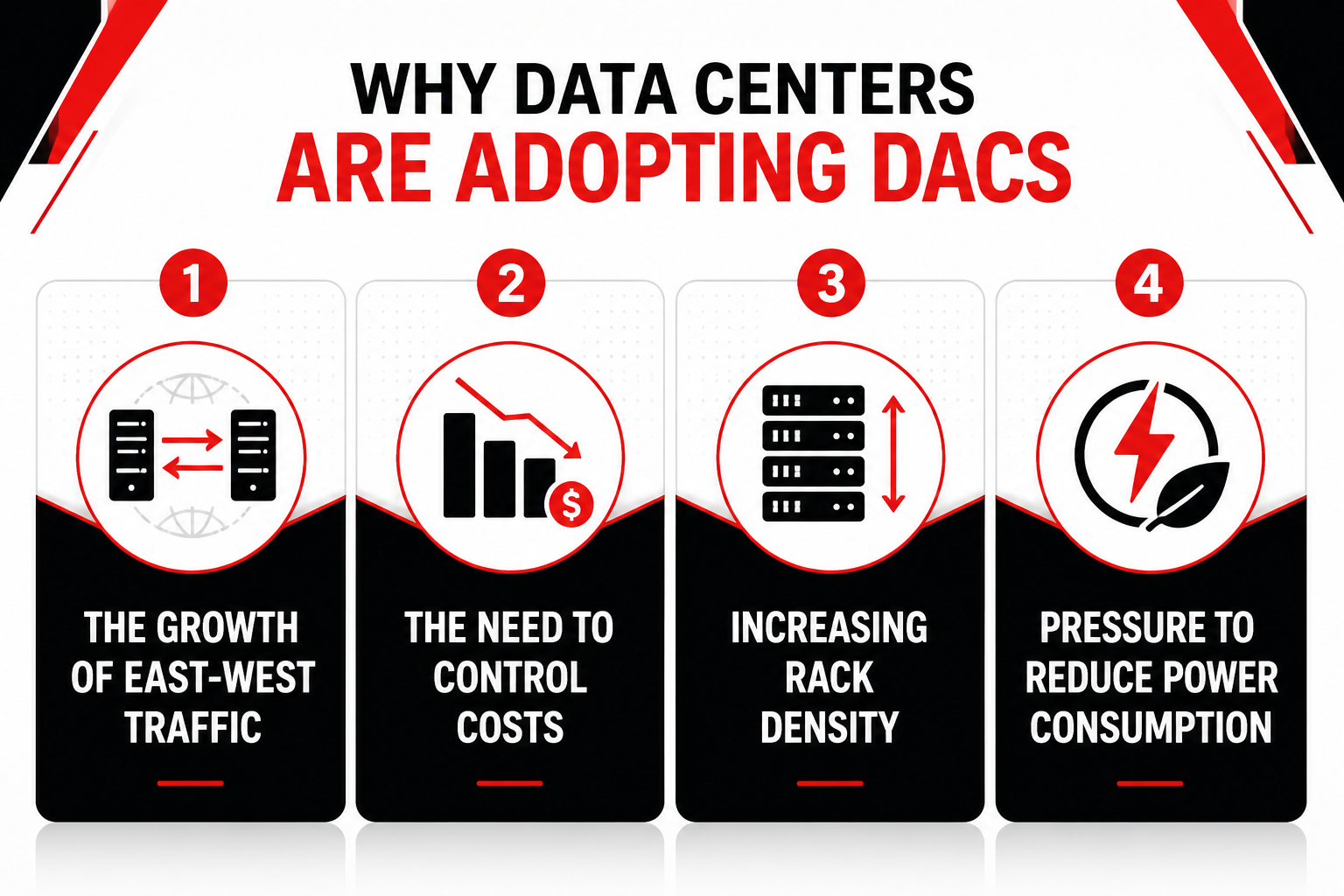
The growing adoption of Direct Attach Cables (DACs) reflects broader changes in how modern data centers are designed and operated. As bandwidth requirements continue to increase, organizations are looking for ways to support higher-speed connectivity while controlling costs, power consumption, and operational complexity. For many short-range connections, DACs provide an efficient way to meet those requirements.

The Growth of East-West Traffic

Modern data centers generate increasing volumes of east-west traffic as applications, storage systems, virtual machines, containers, and AI workloads continuously exchange data across the network. Many of these connections occur within the same rack or between adjacent racks, creating an ideal environment for DAC deployments.

In these scenarios, the extended reach of fiber optic infrastructure is often unnecessary. DACs allow organizations to match connectivity investments to actual deployment distances while still supporting the bandwidth requirements of modern Ethernet networks.

As AI, cloud computing, and distributed applications continue to drive internal network traffic, the number of short-range, high-speed connections inside the data center is expected to grow as well.

The Need to Control Data Center Costs

Network upgrades rarely affect a single connection. Moving from 10G to 25G, 40G, or 100G Ethernet often impacts hundreds or thousands of ports across a data center.

At that scale, connectivity decisions can significantly influence infrastructure budgets. The cost of transceivers, cabling, inventory management, and future replacements quickly adds up, particularly in large enterprise, hyperscale, and AI-driven environments.

DACs help address this challenge by eliminating the need for separate optical transceivers in short-range deployments. By combining connectivity into a single cable assembly, organizations can often reduce hardware costs while simplifying procurement and inventory management.

Increasing Rack Density

Modern data centers continue to consolidate more compute resources into less physical space. Higher-density racks improve resource utilization, but they also create new challenges related to cable management, airflow, power delivery, and maintenance accessibility.

DACs help simplify rack-level connectivity by reducing component count and minimizing installation complexity. In top-of-rack architectures, where servers and switches are often separated by only a few feet, this can translate into cleaner cable management and easier day-to-day operations.

While proper cable management remains essential regardless of the connectivity method used, DACs provide a practical solution for many high-density deployment scenarios.

Pressure to Reduce Power Consumption

Power has become one of the most valuable resources in the modern data center. Every networking component contributes not only to electrical consumption but also to cooling requirements and overall operating costs.

Because DACs use direct electrical transmission through twinax copper cable, they generally consume less power than architectures that rely on separate optical transceivers. Passive DACs, in particular, require very little power because they contain no active signal-conditioning electronics.

While the savings per connection may appear modest, the cumulative impact can become significant across hundreds or thousands of ports. For operators seeking incremental efficiency gains, DACs represent one practical way to reduce overall infrastructure power consumption.

Taken together, these trends help explain why DAC adoption continues to increase. As data centers become denser, faster, and more bandwidth-intensive, organizations are increasingly choosing connectivity solutions that align with actual deployment requirements rather than defaulting to a single technology for every application.

Key Advantages of Direct Attach Cables

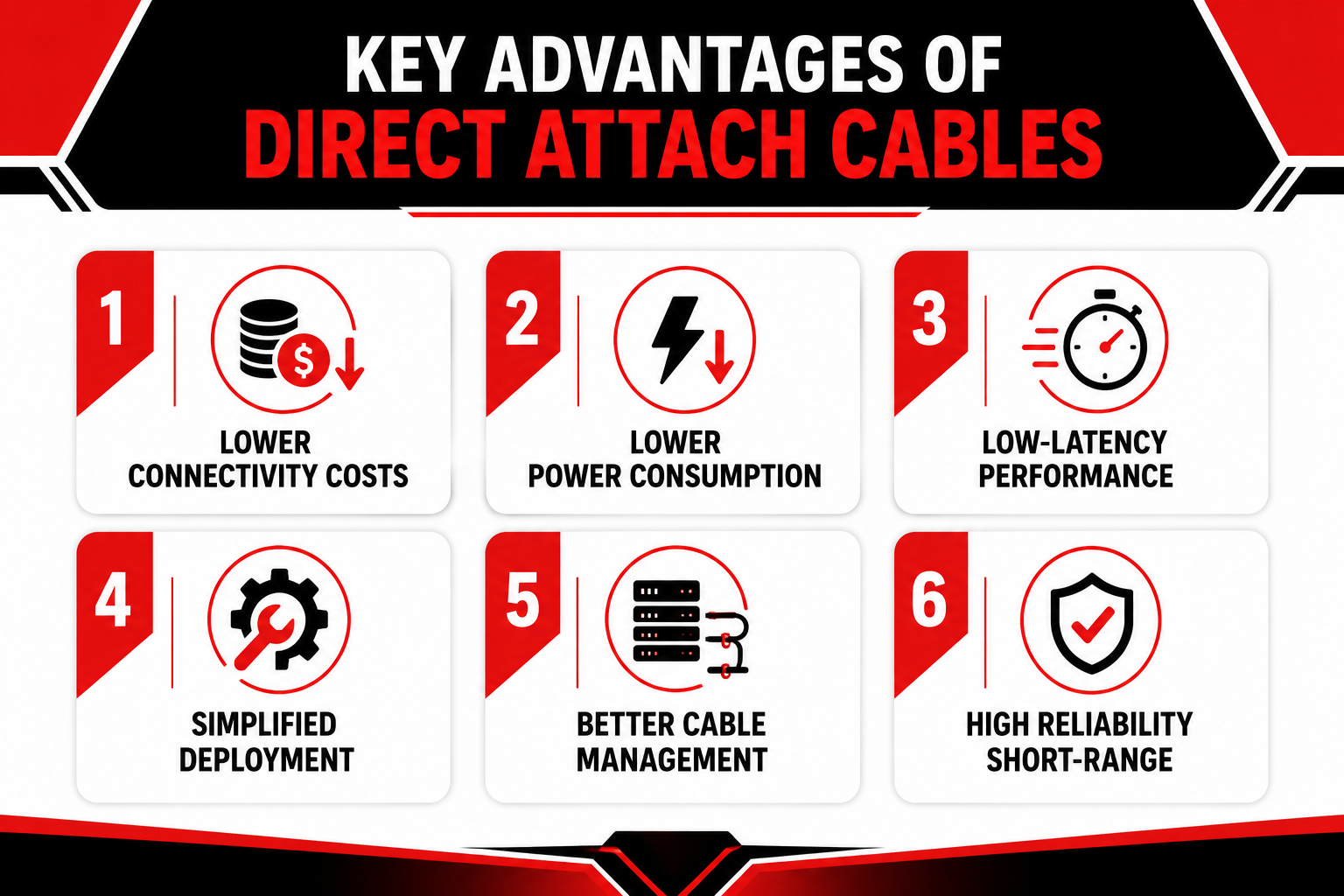
Direct Attach Cables (DACs) continue to gain traction because they address several operational priorities that matter to modern data centers: cost control, power efficiency, deployment simplicity, and performance.

While fiber optic infrastructure remains essential for longer-distance connectivity, many server-to-switch and switch-to-switch connections occur over relatively short distances. In these scenarios, DACs often provide a more efficient balance between performance, cost, and operational simplicity. The value becomes particularly apparent in high-density environments where hundreds or thousands of network connections must be deployed, managed, powered, and maintained.

1. Lower Connectivity Costs

One of the most significant advantages of DACs is their ability to reduce connectivity costs in short-range deployments.

Traditional fiber-based connections typically require optical transceivers at both ends of the link in addition to the fiber cable itself. DACs combine connectivity into a single factory-terminated cable assembly, eliminating the need for separate transceiver purchases and reducing the number of components required for each connection.

For a single link, the cost difference may appear modest. However, as organizations upgrade from 10G to 25G, 40G, or 100G Ethernet and deploy hundreds or thousands of ports, those savings can scale quickly. This is particularly valuable in top-of-rack architectures, hyperscale facilities, AI clusters, and enterprise data centers where connectivity costs can represent a meaningful portion of the overall network budget.

2. Lower Power Consumption

Power efficiency has become an increasingly important consideration as data centers balance growing bandwidth demands with finite electrical and cooling resources.

Unlike optical architectures that require transceivers to convert electrical signals into light and back again, DACs use direct electrical transmission through twinax copper cable. As a result, they generally consume less power than transceiver-based fiber solutions. Passive DACs are especially efficient because they contain no active signal-conditioning electronics.

While the savings associated with a single connection may be small, the cumulative impact can become meaningful across large deployments. Lower networking power consumption can also contribute to reduced cooling requirements and improved overall infrastructure efficiency.

3. Low-Latency Performance

Latency is a critical consideration for many modern workloads, particularly those that depend on rapid communication between systems. Artificial intelligence, machine learning, high-performance computing, storage replication, and real-time analytics environments all benefit from minimizing delays wherever possible.

Because DACs use direct electrical transmission rather than optical conversion, they can deliver extremely low-latency connectivity over short distances. Although the latency difference between DAC and optical solutions may be minimal on an individual link, the benefits can become more meaningful across large-scale distributed environments where systems exchange data continuously.

For organizations optimizing east-west traffic flows, low-latency server-to-switch and switch-to-switch connectivity remains one of DAC's most compelling advantages.

4. Simplified Deployment and Maintenance

DACs simplify deployment by integrating connectivity into a single cable assembly. Instead of installing separate transceivers and fiber cables, technicians can deploy a complete connection using a single factory-terminated solution.

This approach reduces installation complexity, simplifies inventory management, and minimizes compatibility concerns. It also reduces the number of components that must be maintained and replaced throughout the life of the network.

For large-scale deployments, these operational efficiencies can translate into faster installations, simplified troubleshooting, and more predictable long-term maintenance requirements.

5. Improved Cable Management in High-Density Racks

As rack density increases, cable management becomes increasingly important to overall network operations. Poor cable organization can affect airflow, complicate troubleshooting, and make future expansion more difficult.

Because DACs are typically deployed over short distances, organizations can often use appropriately sized cable assemblies that minimize excess cabling within the rack. The result is cleaner cable pathways, improved equipment accessibility, and a more organized infrastructure environment.

In top-of-rack architectures, where servers and switches are located only a few feet apart, these advantages can simplify day-to-day operations while helping support efficient airflow and maintenance activities.

6. High Reliability for Short-Range Applications

The simplicity of the DAC architecture also contributes to reliability. Unlike traditional fiber deployments that depend on multiple discrete components, DACs operate as pre-tested cable assemblies with integrated connectors.

Fewer components generally mean fewer opportunities for compatibility issues, installation errors, or hardware failures. This creates a predictable and repeatable deployment model that is particularly valuable for server-to-switch connectivity, storage networking, switch interconnects, and AI cluster deployments.

For organizations managing large numbers of short-range connections, reliability and operational consistency are often just as important as bandwidth and performance.

DAC Advantages at a Glance

Requirement Why DACs Are Often Chosen
Lower Infrastructure Costs Eliminates separate optical transceivers for short-range links
Power Efficiency Uses direct electrical transmission and often consumes less power
Low Latency Supports rapid communication between nearby devices
Faster Deployment Factory-terminated, plug-and-play cable assembly
Simplified Maintenance Fewer components to manage and troubleshoot
High-Density Environments Supports cleaner, more organized rack-level connectivity

Individually, each of these advantages may appear incremental. Together, they help explain why DACs have become a preferred connectivity option for many short-range networking applications. As data centers continue to scale, the ability to reduce cost, simplify operations, improve efficiency, and maintain high-speed performance remains a compelling reason to deploy DACs wherever their distance limitations align with the application.

DAC vs AOC vs Optical Transceivers: Understanding the Tradeoffs

The growing popularity of DACs does not mean they are always the right choice.

Data center connectivity decisions should be driven by application requirements, distance, scalability, and operational constraints. In practice, most modern data centers use a combination of DACs, Active Optical Cables (AOCs), and traditional fiber optic links. Each option solves a different infrastructure challenge.

DAC vs AOC

DACs and AOCs are often compared because both simplify deployment by integrating connectivity into a single cable assembly. The difference lies in how they transmit data.

DACs use twinax copper cable and direct electrical transmission, making them ideal for short-range connections where cost, latency, and power efficiency matter. AOCs use fiber optic cable and embedded optical components, allowing them to support longer distances while maintaining a lightweight cable design.

For same-rack and adjacent-rack connections, DACs often provide the most practical solution. As distance requirements increase, AOCs become more attractive because they offer greater reach without requiring separate transceivers.

Requirement DAC Cable AOC Cable
Transmission Medium Twinax Copper Cable Fiber Optic Cable
Typical Reach Up to 7m passive, up to 15m active Typically 30m to 100m+
Power Consumption Lower Higher
Latency Very Low Low
Initial Cost Lower Higher
Cable Weight Heavier Lighter
Same-Rack Connectivity Excellent Good
Long-Distance Connectivity Limited Better
Cable Management for Longer Runs Moderate Better
Electromagnetic Interference Immunity Limited Complete

The decision often comes down to distance. If devices are separated by only a few meters, DACs typically provide a better balance of cost and efficiency. When connections extend beyond typical DAC limits, AOCs often become the more practical choice.

Because most modern data centers use a combination of DAC and AOC connectivity, selecting the right solution often depends on distance, performance, and operational requirements. TTI Cable provides both Direct Attach Cable (DAC) and Active Optical Cable (AOC) solutions to support a variety of short-range and extended-reach networking deployments.

DAC vs Optical Transceiver-Based Fiber

The second comparison involves traditional fiber architectures that use separate optical transceivers and fiber optic cable assemblies.

Unlike DACs and AOCs, traditional fiber deployments allow transceivers and cables to be selected independently, providing greater flexibility for distance, architecture, and future upgrades. That flexibility comes with additional complexity, as each connection typically requires transceivers at both ends, fiber cabling, compatibility validation, and ongoing inventory management.

For spine-leaf architectures, data center interconnects, campus networks, and building-to-building links, those tradeoffs are often worthwhile because fiber provides the reach and scalability these environments require. Fiber is also immune to electromagnetic interference, making it a preferred option in electrically noisy environments.

DACs, by comparison, excel when devices are physically close together and when simplicity, power efficiency, and cost control are higher priorities than transmission distance.

Connectivity Selection Framework

Rather than viewing DACs, AOCs, and fiber as competing technologies, it is often more useful to think of them as tools designed for different parts of the network.

Deployment Scenario Recommended Solution Primary Reason
Server to ToR Switch (Same Rack) Passive DAC Lowest cost and power consumption
Adjacent Rack Connections Active DAC Extended reach with minimal complexity
High-Density AI Cluster DAC + Fiber Hybrid Balances performance and scalability
Row-to-Row Connectivity AOC Greater reach without separate transcievers
Spin-Leaf Network Links Fiber + Optical Transceivers Maximum flexibility and distance
Data Center Interconnect Fiber Optic Infrastructure Long-distance transmission capability

The key takeaway is that DACs, AOCs, and traditional fiber solutions should not be viewed as competing technologies. Most modern data centers rely on all three.

The goal is not to standardize on a single technology, but to match each connection to the performance, distance, cost, and operational requirements of the application it supports.

Read Next: How to Choose the Right Fiber Media Converter for Your Network

Where DACs Fit Best

Direct Attach Cables (DACs) offer clear advantages for short-range connectivity, but they are not intended to replace every data center cabling solution.

Their strengths are most apparent in same-rack and adjacent-rack deployments where low latency, power efficiency, and cost control are priorities. As distance requirements increase, Active Optical Cables (AOCs) and traditional fiber optic infrastructure often become more practical because they provide greater reach and flexibility.

This is why most modern data centers do not rely on a single connectivity technology. Instead, they combine DACs, AOCs, and fiber solutions based on the requirements of each application.

Understanding where DACs provide the greatest value is ultimately more important than determining whether they are "better" than alternative technologies. The most effective connectivity strategy is one that aligns performance, distance, scalability, and operational requirements with the needs of the environment.

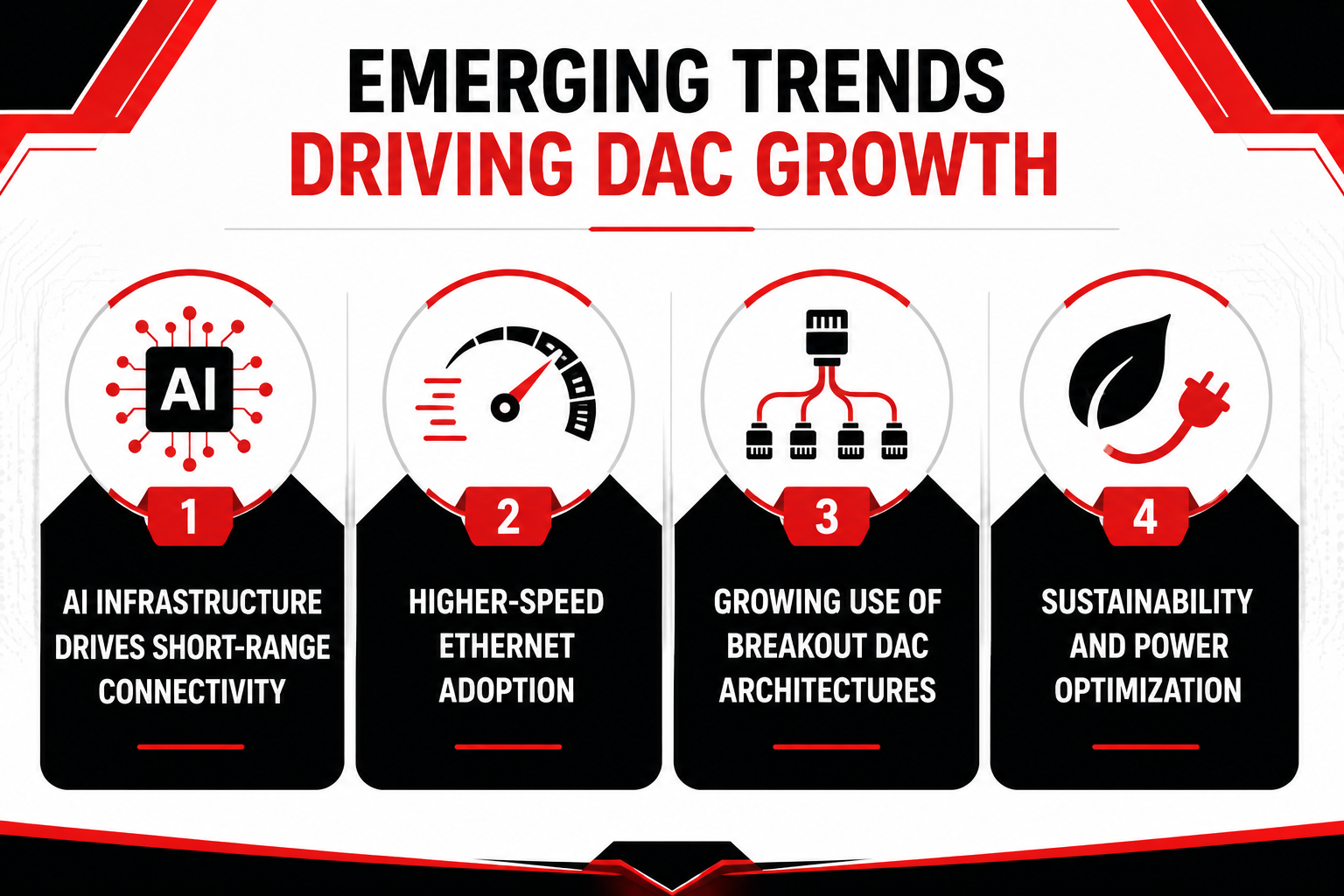
Emerging Trends Driving DAC Growth

The continued growth of DAC adoption is closely tied to broader changes occurring within modern data centers. AI workloads, cloud computing, high-performance storage, and increasingly dense compute architectures are creating new connectivity demands that align well with DAC capabilities.

Rather than replacing fiber optic infrastructure, DACs are becoming an increasingly important component within hybrid connectivity strategies, particularly for short-range, high-speed connections inside the rack and between adjacent racks.

AI Infrastructure Is Increasing Demand for Short-Range Connectivity

Few trends are reshaping data center networking as quickly as artificial intelligence.

AI infrastructure depends on constant communication between GPU servers, storage platforms, network switches, and accelerator clusters. Many of these systems are deployed within the same rack or in adjacent racks, where transmission distances are relatively short, but bandwidth requirements are exceptionally high.

These environments place a premium on low latency, power efficiency, and cost control, all areas where DACs perform particularly well. As organizations continue expanding AI infrastructure, short-range interconnects are expected to remain an important use case for DAC deployments.

Higher-Speed Ethernet Adoption

The transition to higher-speed Ethernet is also contributing to increased DAC adoption.

As organizations move beyond traditional 10G environments and deploy 25G, 100G, 200G, and 400G architectures, they must support greater bandwidth without significantly increasing deployment complexity or connectivity costs.

Modern DAC solutions are available in a range of form factors, including SFP+, SFP28, QSFP+, QSFP28, and QSFP-DD, allowing them to support increasingly demanding network architectures. For short-range connections, DACs provide a practical way to scale bandwidth while maintaining a relatively simple deployment model.

Growing Use of Breakout DAC Architectures

Breakout DACs are becoming increasingly common as data center operators look for ways to maximize switch port utilization.

Rather than dedicating a high-speed port to a single connection, breakout DAC assemblies allow one interface to support multiple lower-speed connections. Common examples include 100G QSFP28 to 4 × 25G SFP28 and 40G QSFP+ to 4 × 10G SFP+ deployments.

This approach can help organizations improve port efficiency, simplify infrastructure growth, and make better use of existing switching investments. As network architectures continue to evolve, breakout DACs are becoming an important tool for balancing performance, flexibility, and cost.

Sustainability and Power Optimization

Power efficiency is no longer just an operational concern. It has become a strategic consideration for many data center operators.

As organizations seek to reduce energy consumption, improve cooling efficiency, and maximize infrastructure utilization, every networking component comes under greater scrutiny. Because DACs generally consume less power than many transceiver-based optical alternatives, they align well with broader efforts to improve operational efficiency.

While DACs alone will not transform overall facility power consumption, they can contribute to larger initiatives focused on reducing networking overhead and optimizing resource utilization.

Taken together, these trends help explain why DAC adoption continues to expand. As data centers become more bandwidth-intensive and operationally complex, organizations are increasingly looking for connectivity solutions that deliver performance while supporting efficiency, scalability, and cost control.

Read Next: Benefits of Fiber Optic Cable for Large Enterprise Networks

When Should You Use DAC?

The most effective connectivity strategy starts with the application rather than the technology.

DACs are typically the best fit when devices are located within the same rack or in adjacent racks and when low latency, power efficiency, and cost control are priorities. This makes them a common choice for server-to-switch connectivity, storage networking, high-density compute environments, and many AI infrastructure deployments.

As distance requirements increase, however, AOCs and traditional fiber optic infrastructure often become more practical because they provide greater reach and flexibility. The goal is not to standardize on a single connectivity method, but to use each technology where it delivers the greatest operational value.

Questions to Ask Before Selecting DAC

Before deploying DACs, consider the following:

  • How far does the connection need to reach?

  • What data rate is required today, and what may be required in the future?

  • How important are power efficiency and operational costs?

  • Will the network need to scale as bandwidth demands increase?

  • Are there any cable management, compatibility, or environmental considerations?

Most modern data centers rely on a combination of DACs, AOCs, and fiber optic infrastructure. The most successful deployments are those that align each connectivity method with the performance, distance, and operational requirements of the application it supports.

Read Next: The Ultimate Guide to Structured Cabling Installation

Choosing the Right Connectivity Strategy for the Modern Data Center

Direct Attach Cables (DACs) have become an increasingly important part of modern data center infrastructure because they provide a practical way to support high-speed, low-latency connectivity over short distances without unnecessary cost or complexity.

Their growing adoption reflects a broader shift in how organizations approach network design. Rather than relying on a single connectivity technology, today's data centers are increasingly matching DACs, AOCs, and fiber optic infrastructure to the specific requirements of each application.

Key Takeaways

  • DACs are best suited for short-range, high-speed connectivity within and between racks.
  • Lower power consumption, reduced hardware requirements, and simplified deployment continue to drive adoption.
  • AI infrastructure, higher-speed Ethernet, and dense compute environments are creating new opportunities for DAC deployments.
  • AOCs and fiber remain essential for applications that require greater reach and scalability.
  • Most modern data centers benefit from a hybrid connectivity strategy rather than a single technology approach.

Before selecting a connectivity solution, evaluate not only current performance and distance requirements but also future growth, rack density, power constraints, and expansion plans. The right choice is rarely about choosing one technology over another. It is about aligning connectivity decisions with long-term infrastructure objectives.

TTI Cable offers Direct Attach Cables (DAC) Solutions and Active Optical Cables (AOCs) designed to support high-speed data center, enterprise networking, and AI infrastructure deployments.

Planning a new deployment or evaluating connectivity options for an infrastructure upgrade? Schedule a consultation with TTI Cable today to determine the right fit for your performance, distance, and scalability requirements.

Frequently Asked Questions

What Is a Direct Attach Cable (DAC)?

A Direct Attach Cable (DAC) is a factory-terminated cable assembly that combines twinax copper cable and integrated connector modules into a single solution. DACs are commonly used for short-range connectivity between servers, switches, routers, and storage devices in data centers and enterprise networking environments.

What Is the Difference Between a DAC and an Active Optical Cable (AOC)?

A DAC uses twinax copper cable and direct electrical transmission, while an Active Optical Cable (AOC) uses optical fiber and embedded optical components. DACs are typically more cost-effective and offer lower power consumption for short-range connections, while AOCs support longer transmission distances.

How Far Can a DAC Cable Reach?

Passive DAC cables are typically deployed at distances up to approximately 5 to 7 meters, while active DAC cables can often support connections approaching 10 meters to 15 meters. Actual reach depends on the cable type, data rate, interface, and equipment compatibility.

When Should I Use a 10G DAC Instead of Fiber Optic Cable?

A 10G DAC is often the preferred choice when devices are located within the same rack or in adjacent racks and when minimizing cost, power consumption, and deployment complexity is a priority. Fiber optic cable is generally a better option for longer-distance connections or environments requiring greater scalability.

What Is a Breakout DAC Cable?

A breakout DAC cable allows a single high-speed QSFP port to connect to multiple lower-speed ports. Common examples include 100G QSFP28 to 4 × 25G SFP28 and 40G QSFP+ to 4 × 10G SFP+ configurations. These breakout cables help improve port utilization and provide greater flexibility when connecting servers, switches, and storage systems.

Are DAC Cables Compatible With All Network Equipment?

Not always. Some networking platforms, including certain Cisco environments, may require specific cable coding or validation to ensure compatibility. Before deployment, verify that the DAC assembly supports the switch, router, server, or storage platform being used.